Monday, February 22, 2021
I have not posted in more than 4 years, wow. I completely forgot how to log in to this site then suddenly I did? Life has changed but I still do art, I am not so focused on weaving as I was in the past, I have expanded a bit. I will post on some of that work later. In the meantime, to all of the zero people reading this, hello!

Friday, June 24, 2016
Work in Progress - Birka brocaded band B20
Since we're int he middle of a move to a new home, I will not have the time or energy to finish my latest project for a while, so in the meantime I am posting some work in progress images. This is band B20 from Birka. Materials used are 60/2 silk, 60/2 linen, and 30 gauge drawn .999 silver wire.
I presented this as a work in progress at Ex Opus, Trimaris' Southern Regional A&S competition event. I won overall highest score and Populace Acclaim. Seeing as the quality of work on display at our humble little Art Sci event was of incredibly high caliber, it was an honor to have my work so highly received.
Now on to the pictures!
Here is the band still on the loom. I have about 45cm already woven, and the finished piece should be ~1.5m long.


And some closeups of the pattern. Here you can see that two silver wires are used for the brocade.


The beginning 1cm is plain weave, followed by 2cm of brocade in silk, as described by Agnes Geijer in Birka III.

I presented this as a work in progress at Ex Opus, Trimaris' Southern Regional A&S competition event. I won overall highest score and Populace Acclaim. Seeing as the quality of work on display at our humble little Art Sci event was of incredibly high caliber, it was an honor to have my work so highly received.
Now on to the pictures!
Here is the band still on the loom. I have about 45cm already woven, and the finished piece should be ~1.5m long.
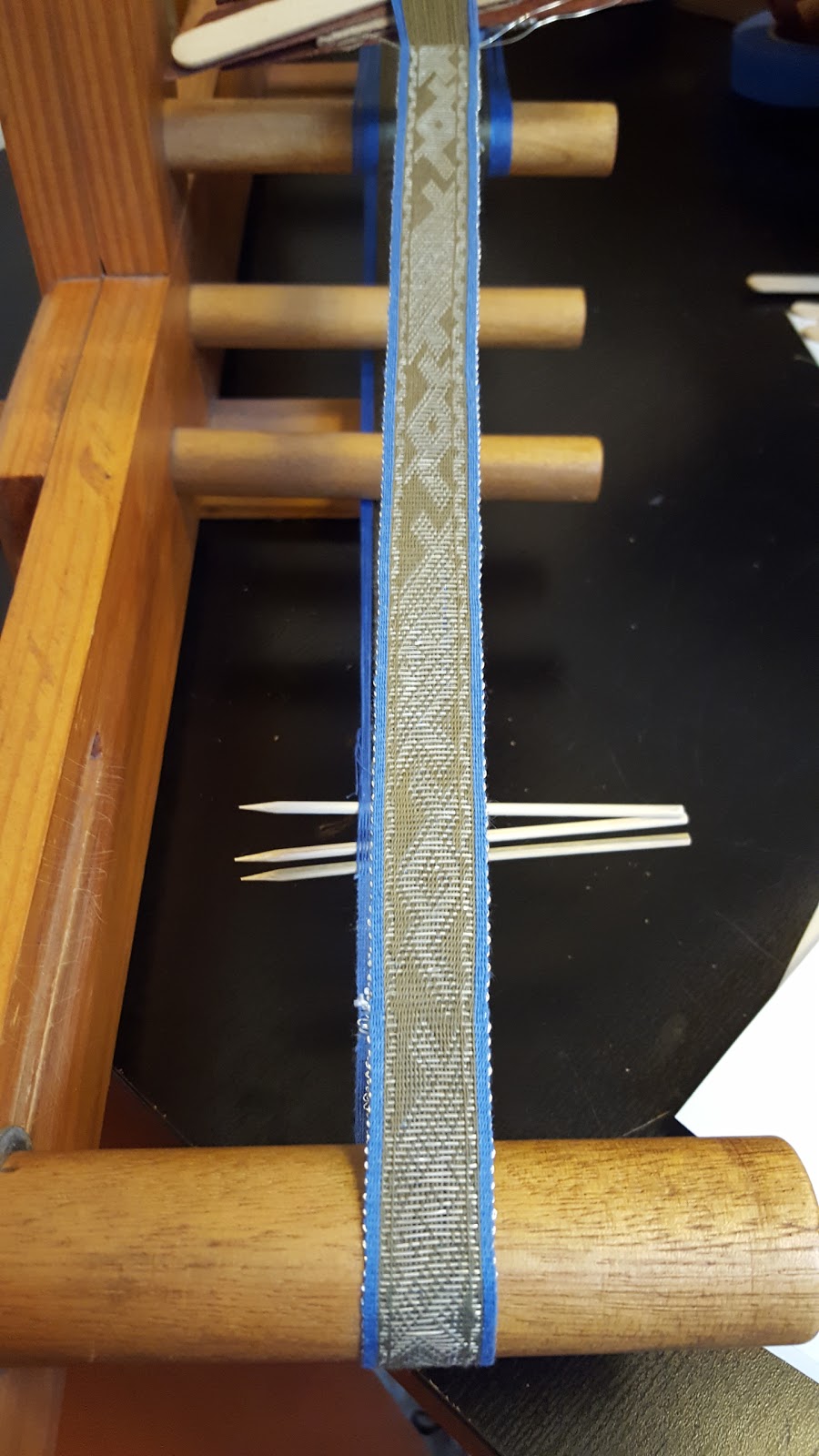
Here is the band in better light. The blue border is linen, which does not exist on the remaining fragments of the band, but there is ample evidence that there was such a border on the piece which has long since deteriorated away.

And some closeups of the pattern. Here you can see that two silver wires are used for the brocade.


The beginning 1cm is plain weave, followed by 2cm of brocade in silk, as described by Agnes Geijer in Birka III.

Monday, May 2, 2016
Reproduction of the Animal Motif Tablet Woven Band from Evebø

For this year's Arts and Sciences Faire in the Kingdom of Trimaris, I chose to make a reproduction of the famous Evebø band. This was by far the most difficult and most fun weaving project I've worked on thus far. There was a huge amount fo research, reading, and translation involved and I am very pleased with the results. This was the first time I enteres an A/S competition at the Kingdom level (second time overall), so I was not expecting to do as well as I did. This was meant to be entered as an Artificer level, but doe to some clerical snafus which went unnoticed due to fatigue, it was entered at the Masterwork level. I was very surprised to have scored very well, earning the Laurel's Acclaim, and this project was selected as one of the Gulf Wars entries for our Kingdom. Unfortunately, I was not able to attend Gulf Wars XXV, but some members of the Kingdom were gracious enough to take the entry on my behalf.
Below follows an excerpt of my report. The full thing is very long, but if you would like to see a full copy, please contact me directly and I would be more than happy to share.
Friday, February 26, 2016
2-Hole Pebble Weave: Reproduction of the Tablet Woven Band “Object I/7” from the Ladoga Burial Mound
The following was my entry into the Regional Art Sci Competition in the Barony of Wyvernwoode, for which I was awarded the title of Baronial Champion. I am making my documentation available here so that it is available to any who wishes to weave this band. Most of this information is freely available on the web, and the Bibliography section has links to the source material.


1. Summary and Inspiration
In 2010, an excavation of burial mounds in Ladoga, Russia
yielded a rich variety of textiles finds believed to originate from the people
inhabiting a nearby Viking settlement. Ladoga is a small town north of St. Petersburg
in Leningrad Oblast, in the area historically known as Karelia. This area is in
far northern Russia in the area bordering Finland. The area was inhabited in
the period from the 10th to 13th centuries by Vikings,
leading up to the Novgorod Rus era of the 13th to 15th
centuries.
The finds at the Ladoga burial mounds have been dated from
between the 10th and 12th centuries [1]. The finds
consist mainly of small fragments at various degrees of preservation, ranging
from small segments of tablet woven woolen bands, to small patched of woven
textile in herringbone patterns. The quality of the fibers varies with some
rich silk originating in Central Asia likely belonging to a wealthy elite.
While some of the fibers were not of such high quality, their co-location with
expensive silks in the same burial mounds indicated they probably were owned by
the same wealthy person or persons [1, 2].
In the present work, a reproduction of a particularly
interesting tablet woven band from the Ladoga burial mounds is attempted. Care
was taken to make use of period materials and methods where possible, although
there were a few differences from the tools used in period, as will be
discussed.
Since the very beginning of my SCA career 2 years ago, I
have been fascinated by fiber arts and specifically band weaving. At my first SCA event, I learned to use the
inkle loom, and was immediately hooked.
Within a month I had woven my first tablet woven band, and have since
endeavored to attempt new historical reconstructions in a variety of
techniques. For my first entry into an
Art-Sci project, I wished to attempt a technique new to me. My choice of this
band to weave for my first Art-Sci project was inspired by the beautiful
reconstructed band form this burial by Silvia Aisling [4] which showed the
delicacy of this woven band. Aisling postulated [4] that the method for weaving
this band should differ from that suggested by the original paper by Kochkurkina
and Orfinskaya describing this find [1]. My attempt at reproduction confirms
this hypothesis, as will be shown presently.
Saturday, January 16, 2016
Weaving in 2015
2015 for me was both an amazing year and a terrible one. I managed to land a dream job, in which for the first time in 7 years I love my job and look forward to going there each day. On the other hand, there were some very difficult losses in our family. All in all, this meant that I have not had the time nor energy to update this blog since April on 2015. This year I promise to do better.
With all that was going on in 2015, my weaving did slow down by quite a bit, but that does not mean that I was not working on some projects. Over the next month I will be updating on those projects, and in order to give myself some accountability, I will outline in this post what is to come:
With all that was going on in 2015, my weaving did slow down by quite a bit, but that does not mean that I was not working on some projects. Over the next month I will be updating on those projects, and in order to give myself some accountability, I will outline in this post what is to come:
- Ongoing work on heraldic garters made as a gift to a friend
- Inkle woven pick-up trim given as a gift to a friend
- Many ribbons made as prizes for the Fall 2015 Shrewsbury Faire
- Reproduction of the Tablet Woven Band “Object I/7” from the Ladoga Burial Mound (this was made as an Artificer entry to the Barony of Wyvernwoode's Art&Sci Competition for 2015, which yours truly became the Champion of).
And that's all that I worked on since 2015. a very short list, but one that I will far exceed in 2016, now that things have calmed down. I am already doing research on a new project which must be completed by February.
Here's hoping to a very busy 2016!
Wednesday, April 29, 2015
New Project: Finnish Iron Age Band Reconstructions - Kakuola Kekomäki 376a
 Ever since getting Applesies, I have been mulling over a larger sort of tablet weaving project. Here is this fantastic book with amazing pattern reconstructions of some historical bands. So, why not go ahead and make it a project to make a reconstruction of every historical band in Applesies, and maybe a few more Iron Age Finnish finds?
I've already made the Masku Humikkala band, but I used non-period materials (cotton and bamboo viscose). For this project, I want to make reconstructions that would not be out of place in period, which means using period materials and methods. I will be working my way through this project throughout the year, maybe spacing it out with some other projects. Each time, I will make an attempt to be more and more authentic in my materials and methods.
Friday, April 24, 2015
Another Applesies Band
 This is a quick update, which is about a month overdue.
I've continued to weave bands from Applesies and Fox Noses, and this time I wanted to take a break from the complexity that was the Masku Humikkala band and chose something simple.
This pattern, called small applesies, has a simple 5-forward, 5-back turning pattern and was thus very quick to weave. Still, I think the pattern is quite striking and very beautiful.
More images after the cut.
Subscribe to:
Posts (Atom)